India trade push could boost Sri Lanka exports by half: ADB
By Shabiya Ali Ahlam
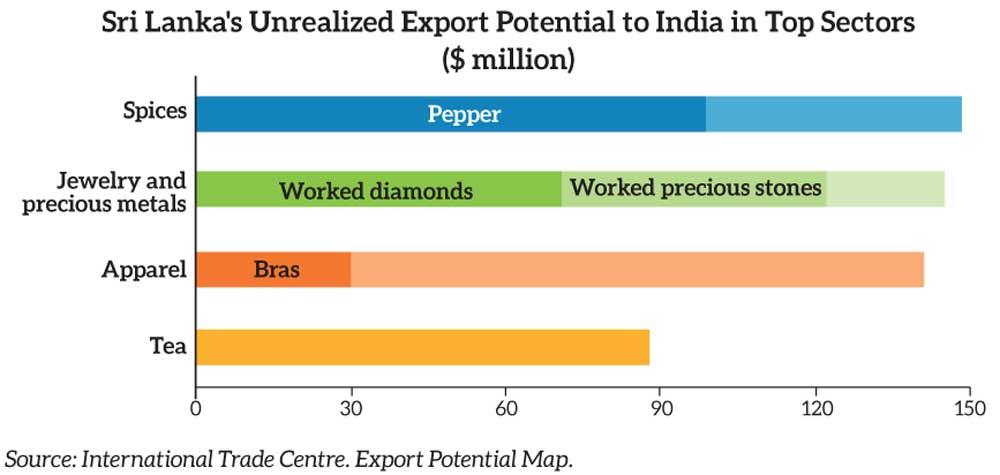
Sri Lanka could expand its exports by as much as 50 percent by deepening the trade ties with India, the Asian Development Bank (ADB) said, while it went on to warn that the island nation’s continued reliance on the Western markets is leaving it exposed to external shocks and constraining growth.The assessment, based on a recent ADB brief on Sri Lanka’s trade potential with India, points to a widening gap between export capacity and actual performance, with the outbound shipments growing by just 16 percent between 2015 and 2024, well below the regional peers such as India, Cambodia and Pakistan.This underperformance has contributed to persistent trade deficits, pressure on the currency and limited foreign reserve accumulation, at a time when the external debt repayments are set to accelerate, stressing the need for a structural reset in export strategy.At the centre of the challenge is a narrow export base and heavy market concentration. Sri Lanka’s exports remain dominated by garments, tea and rubber-based products, while more than half of shipments are absorbed by the United States, European Union and United Kingdom. The ADB brief, authored by Dinuk de Silva, Jules Hugot and Chethana Ranatunga, cautioned that such concentration leaves the country vulnerable to demand shocks, as seen during the pandemic when the garment exports fell sharply.Against this backdrop, India emerges as the single largest untapped opportunity. Sri Lanka has an estimated US $ 6 billion in unrealised export potential globally, of which around US $ 800 million lies within the Indian market alone. Fully tapping this could lift the exports by nearly half, positioning India as a critical lever in reshaping the country’s external sector.The opportunity is amplified by India’s rapid economic expansion, averaging a 7.8 percent growth between 2022 and 2024 and its deeper integration into global value chains. South India, particularly Tamil Nadu, is emerging as a manufacturing hub, creating demand for intermediate goods and services that Sri Lanka is geographically well placed to supply.However, the longstanding trade frictions continue to limit this potential. Despite the Indo-Sri Lanka Free Trade Agreement (ISFTA) being in force for over two decades, Sri Lankan exports still face tariff-rate quotas, restrictive rules of origin and a range of non-tariff barriers, including technical standards and para-tariffs. Only about 60 percent of exports to India currently benefit from the preferential access.The ADB argues that without targeted reforms, Sri Lanka risks remaining on the margins of regional trade integration even as the neighbouring economies accelerate.Key recommendations include upgrading the ISFTA to cover more goods, services and investment, phasing out para-tariffs and fast-tracking trade facilitation initiatives such as a National Single Window, to reduce compliance costs and delays. Expanding the mutual recognition of standards and promoting high-potential sectors could also deliver quicker gains.The broader implication is that Sri Lanka’s export challenge is no longer simply about production capacity but about access. As global trade becomes increasingly regionalised, the country’s ability to pivot, particularly towards India, will be central to strengthening external resilience and sustaining long-term growth.