Greece and India enter negotiations for Port of Alexandroupoli - IMEC Advances
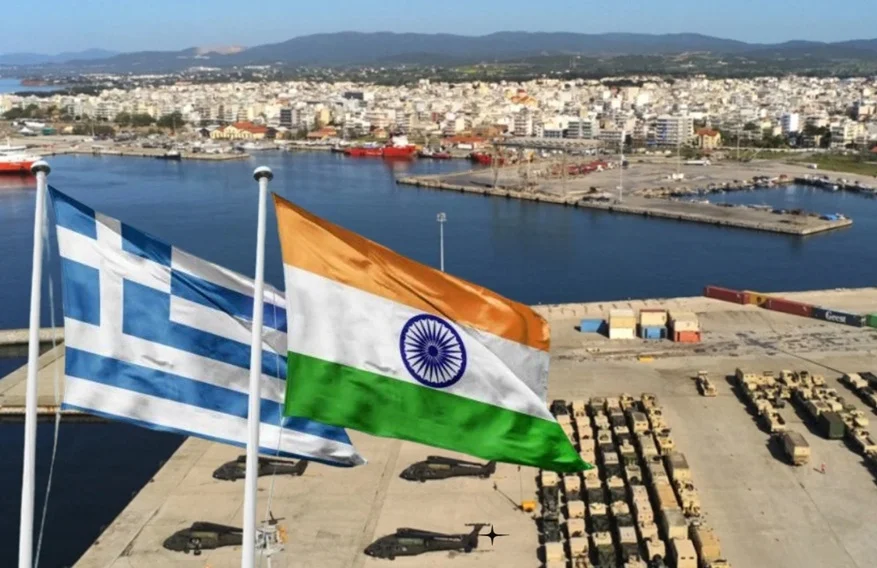
The Greek government is reportedly negotiating with an Indian company to acquire the port of Alexandroupoli, a development that would change not only the map of Greek infrastructure but also the entire region.
The existence of negotiations with an Indian company for a Greek port was first revealed by Eurobank CEO Fokion Karavias at the Delphi Economic Forum. According to well-informed sources cited by Crisis Monitor, the port at the center of the discussions is the port of Alexandroupoli.
This port is not a simple commercial facility. In recent years, it has been upgraded to a critical hub for transporting military equipment, energy cargo, and goods to the Balkans, Eastern Europe, and the Black Sea. Since the war in Ukraine, Alexandroupoli gained even greater value, as it was included in plans for alternative transport routes, decongestion of critical corridors, and addressing the food crisis.
Interestingly, in the past, Prime Minister Kyriakos Mitsotakis had blocked the sale of the port of Alexandroupoli, canceling the Hellenic Republic Asset Development Fund process. At the time, the official justification was geopolitical concerns. In other words, the government had judged that Alexandroupoli was too critical to be handed over to investment schemes without a broader strategic assessment.
Today, however, the possible entry of an Indian company places the matter in a different context. India is not a random player. It is a rising power, a key competitor to China in Asia, and a central link in plans such as IMEC (the India-Middle East-Europe Corridor). If Alexandroupoli is connected to such a plan, the port acquires a role far beyond Greek borders.
At the same time, this development must be understood within the broader puzzle of Greek ports. The port of Piraeus is controlled by the Chinese COSCO, the port of Thessaloniki is linked to Russian-Greek billionaire Ivan Savvidis, and the US has expressed interest in playing a role in creating a port in Elefsina. If the case of Alexandroupoli, with an Indian investment, also goes ahead, then almost all the major hub ports of the country will be under strong foreign influence.
Alexandroupoli is now a valuable piece on the grand chessboard. That is why every move around the port of northeast Greece must be evaluated not only in economic terms but also in terms of national security, alliances, and strategic autonomy.